Occupational Therapy Provides Holistic Support for Cancer House of Hope Members
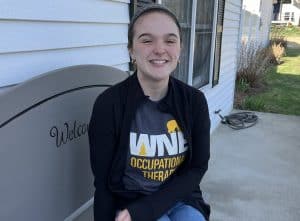
“I just feel like I’m out of a funk,” said a CHD Cancer House of Hope (CHH) member to her student occupational therapist Emily Labrie. “I feel like myself again,” she added.
It was music to Labrie’s ears, reminding her why she chose the field—and why she picked CHH for her doctoral capstone project at Western New England University. CHH provides care and comfort to men and women in treatment, survivors, and family members.
When Labrie was looking for a doctoral experiential project to wrap up her education, she discovered that generally, in Western medicine, OT in cancer care is not only underutilized, but sometimes completely overlooked—especially the treatment of psychosocial issues. “My mother was diagnosed with stage four uterine cancer in November of 2023, and I saw many gaps in her care that were not addressed,” she said. “Traditionally, it’s a chew-you-up and spit-you-out approach instead of providing holistic care. When my mom goes in for appointments, they ask her, ‘On a one-to-10 scale, how stressed are you today?’ And that’s about it.”
Labrie did some research and found CHH, whose program director, Margaret Toomey, answered her call the same day because she saw that OT indeed would fill a need at the house. “I didn’t want the project to be in a hospital-like setting, so I knew this would be a perfect fit, and it was,” she said. “It’s very homey here—not a clinical vibe at all.”
She provided OT at CHH from January through April—the first time such a service was offered there—helping members regain skills needed for daily living. “These are activities such as cooking, grocery shopping, cleaning the house, and taking care of children and pets,” she said. Last March, Labrie even provided a virtual education session on OT in cancer care, giving tips on such strategies as energy conservation and fatigue management—something she routinely did with CHH members.
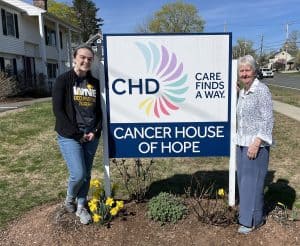
“At Cancer House of Hope, I talked to members about time budgeting,” she said. “It’s not necessarily about remediating the fatigue, but changing your activities to make them more manageable. You take a look at the week ahead and avoid piling all of your most strenuous activities at the beginning of the week so you’re not wiped out for the rest of the week.”
In the virtual session she also provided techniques to manage peripheral neuropathy—nerve damage that causes numbness and tingling in limbs as a result of cancer treatment.
Labrie’s CHH clients also did balance and strengthening activities—in some cases she made home exercise programs for them—and she measured their improvement through a Global Health Scale, as well as other assessments, including the Berg Balance Scale. “We saw improvements in what we call RPE—the Rate of Perceived Exertion—and that is a scale from one to 10 on how much energy is required to complete a task,” she said. “For example, we did a simulated laundry task with a washer and dryer, and some would say, ‘That took everything out of me.’ This was about an eight out of 10 exertion, but after a few weeks of occupational therapy services, their rate decreased to four or five out of 10—a huge improvement.”
Labrie started her capstone project with a mini-occupational therapy clinic with CHH members. “I did a thorough evaluation with them of their physical and mental health, and then I would ask them, as part of the evaluation, ‘What are your priorities? What are you not doing right now that you wish you were doing—what’s interfering with your ability to be the person you want to be?” she said. “From these priorities, we’d collaborate to set goals for their treatment.” After seeing Labrie once a week (some of them twice), they concluded services with a discharge session, where reassessments were done to measure their progress, and then she gave them recommendations for the future to make sure that their progress could be sustained.
Emphasis on Mental Health
OT in cancer care also provides emotional support and coping strategies to help patients manage the psychological impact of a cancer diagnosis and treatment. Labrie noted that there were also marked improvements CHH members’ mental health assessments, including the DASS—the Depression, Anxiety, and Stress Scale. “It’s not about just the physical challenges of cancer, such as fatigue and pain, but the emotional challenge of, say, losing your hair during treatment,” she said. “If you struggle to make your bed first thing in the morning, that’s going to impact how you view yourself and it can take a toll. You see yourself as somebody who’s sick. Of course, there are anxiety, stress, and depressive symptoms that come with a cancer diagnosis—dealing with the unknowns.”
Labrie’s education had a strong grounding in psychology, which was her undergraduate major at Worcester State University. At WNE, she did 12 weeks of fieldwork with adolescent clients at Butler Hospital, a psychiatric hospital in Providence, RI. “A lot of people, when they hear ‘occupational therapy,’ they think of helping somebody who has had an injury or stroke, but not a mental health diagnosis,” she said. “But just think about a time hat you’ve been extremely overwhelmed and stressed, and how that impacts your ability to live your daily life.”
Initially, Labrie thought that after her mother Lauri received her diagnosis, she might be too emotionally connected to the subject to effectively conduct her capstone project at CHH, but her mentors at WNE helped her navigate this issue. “And at first it was hard, but at the same time it was almost therapeutic to be here and see that my family’s not alone in going through something like this,” she said. “It has been extremely rewarding providing support to these people.” At the time, Lauri joked to her daughter, “Emily, I would do anything for you—I even gave you your topic for your capstone project!”
In fact, when Lauri came all the way to western Massachusetts from Blackstone, MA to visit her daughter, she used CHH services herself, including Reiki and therapeutic horseback riding. She has also taken Emily’s advice on time budgeting. “I’m working fulltime, so if I have things to do after work, I can’t frontload all these activities at the beginning of the week, or I’ll be wiped out,” she said.
Lauri pointed out that there is nothing like Cancer House of Hope in the Blackstone area, which is near Providence, even though it is extremely beneficial—and convenient—to have cancer support services, including counseling, support groups, and wellness therapies offered under one roof.
It’s no secret that being told you have cancer can trigger emotions such as anger, fear, stress, and depression, but it’s less obvious where you can find emotional support. “My diagnosis blindsided our family,” Lauri recalled. “The oncologist gave us a list of things to do—you need to get your bloodwork done, you need to start chemo. We didn’t have someone after the appointment to talk to us and say, ‘We know you’re scared. We know this is a life-changing event. Let’s talk about this.’ Western medicine is great, but it would be even better if they treated the whole person. And if we had a Cancer House of Hope in our area, I would definitely use services like yoga and massage.”
Making a Difference
What’s not widely known is that occupational therapists also help patients navigate the health care system and help them with strategies to make sure they’re getting the information they need from, including questions they need to ask their doctors. Labrie recalls one woman who was out of work for an extended period of time because of her chemotherapy treatments and was having a difficult time getting her paid leave extended.
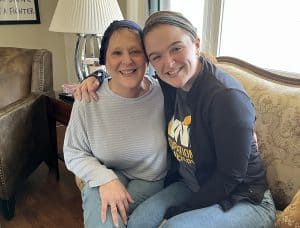
“Together, we walked through the process, found ways to communicate with the health care system and with her employer, and she was able to get her leave extended,” she said.
Labrie is happy she chose such a person-centered profession, at times going beyond the usual therapeutic relationship and forming bonds with those she treats, but at the same time remaining focused on their goals and not becoming too emotionally invested. “Compassion fatigue is a real thing, so you have to set boundaries and know that A-you can’t help every single person in the world, and B-you have to separate yourself from your work,” she said. “You have to remind yourself that if you’re not taking care of yourself, you’re not going to be the best practitioner for your patients.”
Toomey said she would love to offer more occupational therapy services at CHH, and she hopes to find another student like Labrie in the future. In the meantime, Labrie created a referral process for CHH members to visit WNE’s pro bono occupational therapy clinic on its campus.
For Toomey, hosting a student doing an OT capstone project, and being her site mentor, was not a simple affair—there was a strict vetting process, including approval from WNE’s Institutional Review Board. “There was a lot involved in crossing all the T’s and dotting all the I’s with the university to make sure it was the right student and the right facility,” said Toomey. “It worked out because Emily was so invested in what she was doing, and so thorough.”
Toomey said that she has seen an incredible increase in energy among the CHH members Labrie has treated. “It was like night and day,” she said. “A couple of them were in the state of depression, and she helped them work around that depression. We had one woman with neuropathy in her hands and feet, and the improvement we saw in her was just amazing. Emily has made a big difference in their lives.”