Learning Through Play: CHD Early Intervention Program Offers Working Moms Playgroups
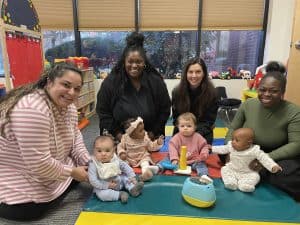 At a recent CHD Early Intervention (EI) program’s Working Moms Playgroup, a musical interlude began with a rendition of “Row Row Row Your Boat,” and nine-month-old Kairo’s face lit up. “Yes, this is still his favorite song,” said his mother Kyrah.
For both Kairo and Kyrah, the playgroup has been a blessing. “It gives Kairo a chance to see other babies doing things that he should be learning how to do,” said Kyrah. And Kairo is thriving now. “Before, he wasn’t interested in toys or any activities a baby should be interested in,” she said. “Now he loves toys. And he’s more interested in other people—he laughs when people look at him.” He’s also developing a close friendship with Helia, another baby in the group.
Kyrah also benefits from these meetups—especially by participating in discussions. “I’m learning how other moms are dealing with such things as managing being a new mom, and going back to work,” she said. “Here, the moms share experiences and help each other out.”
The opportunity for working mothers to connect with fellow moms, share tips, and offer support for one another was the impetus behind the development of two playgroups: a Working Moms Infant Playgroup in the EI suite at the CHD Corporate Office on Birnie Avenue in Springfield, and a Working Moms Toddler Playgroup at CHD’s Prospect Center in East Longmeadow.
CHD’s EI program works with children from birth to three years of age who have—or are at risk of—developmental delays. However, EI Program Supervisor Cindy Napoli (pictured top left) found that both mothers and children would also benefit from activities aside from the EI sessions—and specifically after working hours.
“Last year I had a student intern conduct a needs assessment, and it was found that a lot of the parents I work with aren’t able to go to playgroups during the day, and they are trying to figure out the role of being a new mother, and at the same time they are transitioning back to work,” said Napoli. “The groups developed out of a need of friendship and community, and a need for a sounding board for questions like, ‘How do you do find time to do self-care?’ In fact, we have a ‘question of the day.’ Questions are collected in a bucket and one is drawn every time we meet.”
Developing Social and Motor Skills
Playgroups help with children’s development, preparing them for school in an informal environment. While social skills can be encouraged at home, the social opportunities provided in a playgroup are invaluable. When children play with their peers, they’re also learning how to share, negotiate, and resolve conflicts. “Play is the gateway to cognition,” said Napoli. “They learn how to set boundaries, how to take turns, and how to label and name colors. Some of our kids don’t communicate with words, so we find other ways to communicate. We’re using sign language, and our speech therapists are making communication boards. So they’re developing motor skills and confidence, from playing on the floor, and then from walking around, painting, and sharing toys. We do a lot of singing and movement, because that facilitates language and play.”
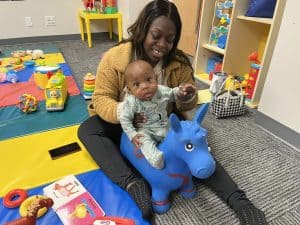
During a recent infant playgroup, mothers and babies, including Camille and her 10-month-old daughter Harley, sing “If You’re Happy and You Know It.” “I’m a first-time mom and I really don’t have any mom friends,” said Camille. “My friends don’t have kids yet. So this is my outlet. We’ve developed a real sense of community here. One time, we talked about our birth stories, which is a really private, intimate thing. It was nice. I can be very vulnerable here—and at the same time comfortable. As we’ve said before, ‘What you say in here stays in here.’”
According to Napoli, the toddler playgroup, headed by Developmental Specialist Karen Wheeler, is more child-focused, while the infant playgroup is more parent-focused. “With our infant playgroup’s ‘question of the day,’ I might lead it with a question, but it mostly consists of moms giving one another then answers,” said Napoli. During a recent talk, there was a discussion about a gym in Enfield, CT that specializes in birthday parties for babies, which several mother took note of. In fact, they apprise one another about everything from parenting issues to practical information on baby-friendly venues. Every session is ended with a gratitude affirmation. “Many of the moms feel that when they go back to work they don’t have enough time for their baby, and not enough time for themselves, but it’s still important to be thankful for everything,” she said.
Helia’s mother, Leila, credits the infant playgroup with “helping me get out of the house and work through my postpartum depression. It has given me a comfort space, and I’m able to open up.”
New Adventures
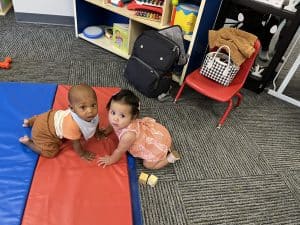
The focus of the playgroups is on encouraging each child to explore their environment in a safe and fun way, and taking part in new activities, such as playing in messy media (including food color and paint), and arts and crafts. For example, moms made an Easter artwork by dipping their babies’ feet in paint and making large footprints on an “Easter Bunny” (on each bunny’s face was a cutout photo of each baby—pictured bottom left). “We made maracas last week,” said Napoli. “When they get to be six months old, we do a lot of education and activities around food to lessen the anxiety of feeding a baby,” she said. Indeed, introducing solid food can cause stress among parents, but they start with small portions, and parents learn about food texture progression—from puree to diced foods. “They share their babies’ feeding experiences with one another, so the moms are getting more adventurous in trying new foods,” said Napoli. In the infant playgroup, Kairo has led the way in this regard, adding to his menu miso soup, burritos, and jerk chicken. “He tried pureed bison this week,” said Kyrah.
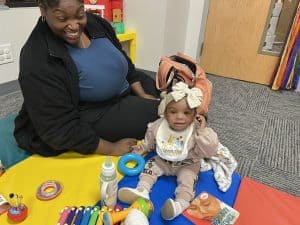
The infant playgroup even enjoyed a baby yoga session led by EI Physical Therapist Diana Kenney. Baby yoga has been known to strengthen parent-and-child bonding, enhance motor development, and reduces stress.
Kairo, who has benefited from both occupational therapy and physical therapy at CHD’s EI program, tended to be stiff and tense, a condition known as hypertonia. “Now he’s nice and loose, and wiggles like a worm in my arms,” said Kyrah.
The fact that Kairo sees other babies moving around during playgroup has helped, she added.
Camille agreed. “When Harley watches other babies, she mimics what they’re able to do, so it helps with her motor skills,” she said. “She’s hitting milestone after milestone as she gets older.”
Meeting a Demand
Napoli said the need for after-work playgroups in the area is clear. EI shares with playgroup participants the resources of Pathways for Parents, a nonprofit organization, which publicizes area playgroups, but these get-togethers usually take place during the workday. “And there aren’t any Saturday or Sunday playgroups,” she said.
Both CHD EI playgroups last an hour (4:30 p.m.-5:30 p.m.). The infant playgroup meets on Wednesdays, and the toddler playgroup meets on Thursdays. For more information, call 413-739-3954.