The Benefits of Baby Yoga
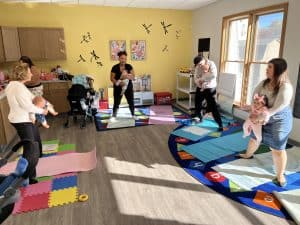 Diana Kenney, a physical therapist in CHD’s Early Intervention (EI) program, has always enjoyed doing yoga herself, so when she heard about baby yoga, she was intrigued: “Baby yoga? Really?” she asked. What she found was a low-maintenance activity that offers babies and parents physical, mental, emotional, and social benefits.
A year ago she took two classes offered by Childlight Education Company and became certified in baby yoga instruction. “I was hooked on it,” she said. Now she teaches baby yoga for EI at CHD’s Prospect Center in East Longmeadow. During the classes she demonstrates, with a baby doll, positions that are within a baby’s natural range of movement while parents watch her and emulate these poses with their children on floor mats. Luz Guzman, an EI administrative assistant, translates Kenney’s instructions into Spanish for Hispanic participants.
CHD’s EI program works with children from birth to three years of age who need extra help learning to walk, talk, or reach other milestones, and while baby yoga is beneficial for all babies, it is particularly helpful for babies with developmental delays.
Baby yoga helps develop fine and gross motor skills and provides crucial “tummy time” on the floor—necessary for building neck, shoulder, and core strength in babies who are often confined to items such as bouncy seats, strollers and car seats. The classes also calm babies’ restlessness, and enable parents to gain more confidence handling their infants.
According to Kenney, it is well-proven that regular yoga relieves tension and stress in adults. However, babies hold tension in their bodies just like us, so baby yoga helps with their emotional regulation. Paris, whose three-month-old Lennox has torticollis—a condition where a baby’s neck muscles become tight and cause the head to tilt—said the class, along with physical therapy and occupational therapy from CHD’s EI program, has aided her son immensely. “His head didn’t stay up the way it should, but now the tension in his neck has diminished,” she said. “I try to practice as much tummy time as I can. He also struggled with breastfeeding but he has been latching on better. With breastfeeding, my confidence has improved because before I felt like I wasn’t doing my job. Lennox is also more engaged—he focuses better than before.”
Paris demonstrated the “airplane” pose, in which she held Lennox under the chest and lifted him up, her boy resembling a little airplane, to help him build neck, back, and core strength.
Kenney said that baby yoga is an excellent way to help children improve their flexibility and strength and support balance. “It encourages babies to go into developmental positions that they usually achieve at certain milestones in their growth,” she said. “It enhances motor development.”
At a recent baby yoga class, Kenney began her instruction with a calming warmup of everyone chanting the spiritual mantra “om,” setting a tone of focus and harmonizing the mind, body, and spirit, and then they performed a gentle baby massage, beginning with the shoulders and moving down to the elbows and hips. When they got down to the feet, they used reflexology, which involved applying light pressure to specific points on the babies’ feet to correspond with different parts of the body.
“If you do a pressure point just above the ball of the foot, it can relieve constipation, and if you do a little pressure on the tops of the toes it can help with teething soreness,” said Kenney.
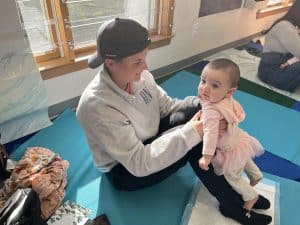
Then the mothers brought their babies legs up and rotated them clockwise and counterclockwise, a move that also helps with digestion.
A “bridge” pose, where a parent helps a baby lift their hips off the floor, helps develop balance and coordination. Criss-cross, in which babies are guided to touch their left foot with their right hand, and then vice versa, promotes a strong link between the left and right brain hemispheres—important for developing motor skills like crawling and walking. “This cross-lateral connection is also a great brain-builder,” said Kenney.
“Kicking cobra,” in which kids lay on their stomach and lift their heads and feet, “strengthens core muscles, as well as the neck and lower back,” she said.
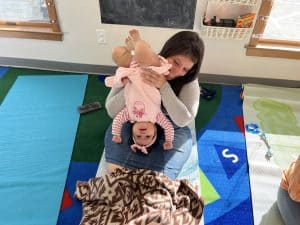
And then came the plank position, which loosens the babies’ shoulders. In an “inversion” pose, a mother, Roselyn, sat with her legs bent and knees together, and while cradling and protecting her baby’s head and neck, gently lowered her seven-month-old Deborah upside down over her knees. “This helps with vestiblular stimulation,” said Kenney. “We certainly don’t push any position that they don’t want to do—or if they’re crying and fussy.”
In “Baby Pole, Baby Planet,” the babies lie on their backs and the mothers hold their hands, singing “North Pole” while touching their heads and then moving to their feet, singing “South Pole.” They continued singing: “East Coast, West Coast, baby you’re the very best.” Their kids smile and wiggle with delight.
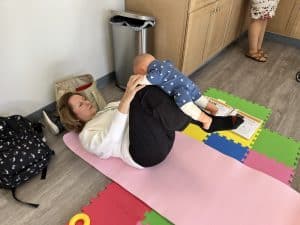
After a few more different poses, the session wound down with a visualization component: “Alexa, play relaxation music,” said Kenney, and the voice-powered device followed her command. Kenney turned to the mothers and said, “Lie on your back and put your baby on top of you. We’re going to close our eyes and pretend you’re on a big, white, fluffy cloud high in the sky. You’re floating very peacefully—light as a feather. As I count one, two, three, imagine that you’re sinking deeper into the cloud. The cloud is all around you.” Each session ends with a relaxation period, followed by a good-bye song.
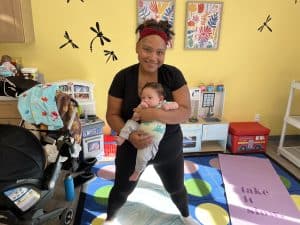
After the session concluded, Roselyn said she finds that EI services, enhanced with baby yoga have helped make Deborah much less cranky, with fewer tantrums.
This session was Emily Boucher’s first doing baby yoga with her six-month-old Vaeda, who is receiving EI services from CHD. “She is getting occupational therapy and physical therapy, and they suggested baby yoga for a little bit of extra movement for her core,” said Boucher, nursing director for CHD’s Meadows Homes. Vaeda had a “failure to thrive” diagnosis, mainly because of an allergy to milk protein, and because of this, in her early months she vomited often and didn’t move much. “She has GI problems, but she’s doing better,” said Boucher. Vaeda seemed to enjoy her first yoga class. “She likes to socialize,” she said.
Indeed, Kenney said baby yoga provides socialization for both parents and babies by creating a supportive environment for parents to connect with one other and for infants to interact with other babies. “And singing songs stimulates language,” she said.
The class also gives them the gift of having undivided attention from their parents. “They put their phones away—it’s their special time with their child for one hour a week.”