Providing a Haven for Teenagers in Chicopee
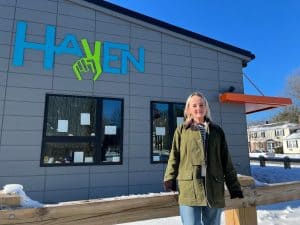
Dagmara Krotki (pictured), a clinician at CHD’s Gateway Community Behavioral Health Center (CBHC), has always enjoyed working with teens. Indeed, providing services at the Haven Teen Center gives her the opportunity to lend the helping hand that she herself would have benefited from when she was an adolescent.
“Being a teenager is difficult, and many of them at the Haven Teen Center are at a point in their lives where they really need guidance,” she said. “I’ve been in their shoes before—not having anyone I could talk to about my mental health. Being someone they can look up to and feel comfortable opening up to motivates me to be the person I once needed.”
The Boys & Girls Club of Chicopee opened the Haven Teen Center more than a year ago. Adjacent to the Club’s main building, the new facility is filled with resources tailored to teenagers’ growth, creativity, and enjoyment. It offers such activities as homework help and tutoring, games, college tours, athletics programs, and the opportunity to use digital media and music equipment. Krotki has been assisting the adolescents there several hours a week since it opened. “During my time there on Tuesdays, we focus on team building, mindfulness, and affirmation-based activities,” she said. “These activities help them work together, build trust, and learn ways to better care for their mental health.”
Through grant funding, over the past three years, the CBHC has been supporting behavioral health and emotional needs of grade- and middle-schoolers at the Boys & Girls Club of Chicopee at its main building. Penny Dugan, the outpatient youth services coordinator and clinician at Gateway, has been delivering those services for two years, and Krotki has taken on that similar role at the Haven Teen Center. Boys & Girls Club children, teens, staff, and family members benefit from a streamlined referral avenue as both Krotki and Dugan facilitate quick access to psychiatry, In-Home Therapy, Therapeutic Mentoring, and other CHD services.
Krotki’s efforts fill a resource gap for services to teens who often encounter a wait list when wanting to deal with mental health issues. Simply put, the longer the wait list, the more damaging it is for the individual. “Many teens and young adults struggle to access mental health or have difficulty opening up about their feelings and thoughts,” she said. “I can offer help directly in the environment where they spend most of their time after school. I can remove the barriers and be more consistent and approachable at the Haven Teen Center.” Teenagers often experience rapid changes in mood and behavior, but when their demeanor interferes with daily life, it could indicate a larger mental health issue. When that is the case, the sooner a teen receives help, the better the outcome. “Long wait lists often push them into needing a higher level of care or decrease in mood,” she said. “A streamlined referral process allows for quick stabilization and connection to ongoing support.”
Helping Teens—and Their Parents
Stephanie Serrano, director of programs at the Boys & Girls Club of Chicopee, said that Krotki has helped the Club offer many more supports for its teens. “If they don’t want to talk to our staff about their needs, it’s great to have a person working alongside us,” she said. “It’s like having a school counselor here one day a week. She has helped us refocus how we serve teens in our community. Last week, for example, we had a meeting with a parent of one of our members because the kiddo had been really struggling, and had been emotionally detached—not engaged at all. It was a relief for his mom to know that it’s almost like having a school guidance department here for her child to talk to.”

Serrano explained that the Club works with many teens who have young and first-time parents that are “learning parenting as they go”—mothers and fathers who might not know how to handle their children’s mental health issues. “I’ve seen a huge change in a lot of our families that have received therapy,” she said. “Our partnership with CHD enables us to refer them to supportive resources in the community.” Some of the teens are in one-parent households who have increased stressors like poverty—but paradoxically they face greater barriers to accessing mental health services.
“Some of the teens might be living with a grandparent or aunt, or they might not even be placed with their biological families—or living in a group home,” said Serrano.
She said that Krotki works as a support for not only teens and parents, but also Club staff, who work hard to help facilitate the kids’ growth. Staff certainly welcome assistance in getting the teens to discuss their feelings at length. “Our average floor staff doesn’t have that kind of experience,” said Serrano. “She bounces new ideas off me and helps staff have better approaches with the kids.”
One idea Krotki had was connecting with the Hampden County Sheriff’s Office to bring a team of therapy dogs to the Haven Teen Center for a couple of visits. The Emotional Support Division of the Sheriff’s Office, which has staff members paired with therapy dogs to uplift their employees and incarcerated individuals, took three dogs to the Center to boost spirits and reduce stress and anxiety. The teens instantly bonded with their new furry friends and played fetch with them.
Zoning in on Emotions
Krotki incorporates Zones of Regulation, a system to categorize how the body feels, as well as emotions experienced, into four colored zones (blue, green, yellow, and red) with which the students can easily identify. “The Zones of Regulation is a social–emotional learning framework designed to help children and adolescents understand emotions, build self-regulation skills, and develop strategies to manage their feelings and behaviors,” she said. “I use Zones of Regulation to check in with the teens before starting the weekly activity.”
Being able to help teens improve their mental health has brought Krotki much gratification in her young career. After earning her BA in psychology from Western New England University and her MEd in Clinical Mental Health Counseling, she worked at another mental health agency in a group home and at a crisis center before joining the CHD team in December of 2022. “I’ve always felt passionate about this work,” she said. “I knew this was the role I wanted to pursue after earning my master’s degree. It’s incredibly fulfilling to know that I get to play even a small part in a teen’s journey during such an important time in their life.”
Krotki points out that emotional and social wellness is especially important for teens because this stage of life is full of development and major transitions—a time when an intervention can open a critical window through which mental health can be promoted. “Getting support early helps them build strong coping skills that they can carry into adulthood,” she said. “How teens feel about themselves during these years greatly influences the choices they make, the relationships they form, and the risks they may take as they grow older.”