Jory Fleming, a Rhodes scholar and climate scientist who has autism, once wrote, “The one blanket statement that I can make about autism is that there is no blanket statement to be made about autism.”
The quote is from his book, “How to Be Human: An Autistic Man’s Guide to Life,” and Kwame Osborne, an autistic resident of a CHD group home in East Longmeadow, couldn’t agree more. “I would love it if we could erase the idea of a blanket statement and focus on the individualistic attributes of people with autism,” said Osborne at a recent gathering entitled “Autism Awareness in Action: A Live Learning Event.” The get-together was hosted by CHD’s Diversity, Equity, Inclusion, and Belonging Committee at the CHD Training Center in Springfield.
The event featured an overview of Autism Spectrum Disorder (ASD) and a presentation by Laura Scott, a Board-Certified Behavior Analyst in CHD’s Community Based Day Support (CBDS) program, who like Osborne, stressed that people with autism are multifaceted.

She explained that the Diagnostic and Statistical Manual of Mental Disorders defines ASD by persistent deficits in social communication/interaction and restricted, repetitive patterns of behavior, interests, or activities, as well as sensory processing differences. But autism is a broad spectrum—no two autistic people are the same. It is a complex, multidimensional condition. “They may overreact to stimuli that neurotypical people wouldn’t react strongly to, or they may underreact,” she said. “I have clients whose parents say, ‘He doesn’t know when he’s cold. He’ll go out on the ice without his socks and shoes on,’ or ‘We can’t go to the mall because the lights bother him. I can’t play any music in the car because the sound is too painful.’”
Indeed, many autistic individuals experience sensory hypersensitivity, and exposure to loud, unpredictable noises or bright, flickering lights can cause extreme discomfort. Osborne, who was diagnosed late in life—as a freshman in high school—said that loud noise does annoy him, especially when people blast music at top volume. “That’s my biggest struggle in society,” he said. “But lights don’t really bother me. As for intensely focused passions, which characterize some neurodiverse individuals, Osborne does have keen interests in some subjects—like everyone—and these include documentation of important events and papers, his family history (he is related to former presidents George H.W. Bush and George W. Bush), photography, and the sport of curling.
“There are similarities between some autistic people engaging in their intense interest and obsessive-compulsive behavior,” said Osborne. “Research suggests that autistic people may be more likely to experience obsessive-compulsive disorder, which I do not have.”
Verbal Challenges
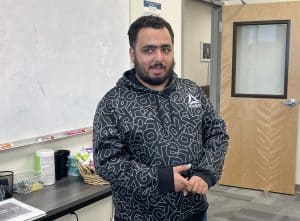
“Kwame has excellent verbal skills, and some people with autism have no communication deficits,” said Scott. “Some people with autism may use speech approximations, or they may have no vocal, verbal speech at all. Behavior analysts and speech language pathologists utilize alternative augmentative communication, such as speech generating devices and picture exchange system communication (PECS) packs to teach functional communication, so people without speech can get their wants and needs met.” PECS packs, which utilize picture icons, symbols, or photographs that users exchange to share thoughts, are sometimes used by speech therapists in CHD’s Early Intervention program.
Autistic babies, as opposed to neurotypical babies, process information differently because their developing brains have unique neural connectivity. Instead of instinctively focusing on social cues, they tend to process information from “bottom-up”—prioritizing intense sensory details.
“From the time that the neurotypical babies are born, they’re getting all kinds of sensory input, and their brains learn to filter out what we kind of consider irrelevant stimuli,” said Scott. “Neurotypical babies will focus on their caregiver’s face and eyes, because a baby needs to know if their caregiver is paying attention to them. If the caregiver isn’t and the baby needs something, they’re going to need to do something like cry. So they learn to focus mostly on their caregiver’s face and eyes, and they learn to tune out the extraneous stuff happening in the background.”
“What happens in an autistic person’s brain is that that their filtering happens differently,” she continued. ”They’re not necessarily tuned in on their caregiver’s face. Some are, but some aren’t. Some are more tuned in on things they hear happening on the other side of the house—or a dog that’s barking out on the street, or the way that their clothes are feeling—and that sensory input is overtaking what we would typically consider kind of the relevant stimuli for an individual.”
ASD Services at CHD
CHD has several services, supports, and referral options for people with ASD, including our Early Intervention program (see below), primary care physician services for people with intellectual disabilities and ASD, therapy services, peer mentoring for children through the state Department of Elementary and Secondary Education, day programming (CBDS and Hawthorn Adult Day Health programs), and residential programming—including CHD’s new ASD Outreach Program.
In addition, for the past seven years CHD has worked with Springfield College’s Department of Occupational Therapy and the Springfield Thunderbirds to host an annual sensory friendly hockey game. Because people with ASD and other bio-neurological conditions can become overstimulated by the intensity and variety of the stimuli during a live hockey game, the game presentation features decreased stimuli in microphone, music and goal horn volume and consistent lighting throughout the seating bowl. There is also a “sensory story” booklet and other supportive items made available by the Springfield College OT Program, who also facilitates two quiet cool-down stations.
The Power of Early Intervention
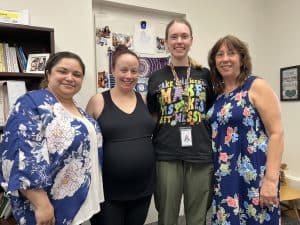
CHD’s Early Intervention (EI) program, in addition to helping children meet developmental milestones, as well as a range of other needs, also works with children on the autism spectrum and their families to address areas where support is needed.
“We don’t diagnose autism, but we do look at the behaviors that might signal concerns, such as not using any words by the time they’re 18 months old, or not being able follow if you’re pointing at a picture or pointing to an airplane outside,” said EI Program Supervisor Cindy Napoli.
If EI notices what they call “red flags,” then they use screening tools, including the M-CHAT (Modified Checklist for Autism in Toddlers), the ASQ-SE2 (Ages and Stages Questionnaire, Social Emotional Second Edition) and the RITA-T (Rapid Interactive Test for Autism in Toddlers), according to EI Developmental Specialist Jessica O’Connor. “If they score high on these and other screening tools, then we would refer them to an outside evaluation,” she said. “If an autism diagnosis is made, then we will continue to provide strategies for families and make other referrals,” including applied behavior analysis services.
Autism red flags before the age of three center around delays in social interaction, communication struggles, and repetitive behaviors. Key indicators include the child not responding to their name, avoiding eye contact, using few or no words, or lacking simple gestures like pointing.
Key red flags to watch for include:
Social interaction: The child rarely makes eye contact, avoids playing with peers, doesn’t respond when called, and struggles to share focus on objects (e.g., doesn’t look where you point).
Communication: Significant speech delays, such as not speaking in simple two-word phrases by age two, or the loss of previously acquired language or social skills.
Behavior and Play: The child displays repetitive movements (e.g., hand-flapping, rocking), rigidly lines up toys instead of playing functionally, or shows an extreme need for routine that results in distress over minor changes.
Sensory Issues: Unusual, extreme reactions (overly sensitive or under-sensitive) to everyday sounds, lights, touch (e.g., clothing tags or seams), or smells and tastes.
Occupational Therapist Nicole Owen said that EI will notify families of resources in the community, depending on the path they want to take. “If they say, ‘I don’t know what to do next,’ we can walk them through the options,” said Owen.
EI’s play-based routines, combined with therapies, can yield promising outcomes. These gains are particularly gratifying for the CHD team and the parents. “When a parent tells me her kiddo was making eye contact with her, or ‘He pulled my hand so that we could sit on the floor together,’ or when a child is communicating with a parent for the first time, it’s really a special time,” said Occupational Therapist Sarah McCarthy.
The sooner a child on the autism spectrum gets help, the greater the chance for progress. In fact, recent guidelines suggest starting an integrated developmental and behavioral intervention as soon as autism is diagnosed or seriously suspected. Learn more about CHD’s EI program, including developmental milestones to observe from birth to age three.