CBDS offers a safe, stimulating environment that allows individuals to explore recreational and volunteer activities while building skills that promote independence.
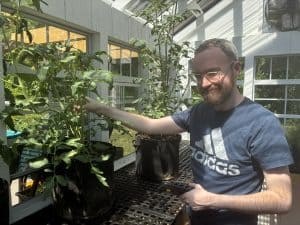
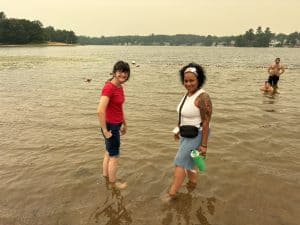
Clients in CHD’s Chicopee-based Community Based Day Support (CBDS) program for people with intellectual and developmental disabilities take part in a wide variety of activities, including life skills training, swimming, karaoke, board games, miniature golf, go-karting, and field trips to such places as Look Park in Northampton, Skinner State Park in Hadley, and the Bridge of Flowers in Shelburne Falls.
Their favorites? That’s a tough one. “There are some clients who don’t like a lot of physical activity, and there are some that do,” said CBDS Activity Coordinator Ana Marquez. “The more active clients especially enjoy bowling, fishing, and playing cornhole.”
“I really like fishing,” said Jeannie during an outing at Hampton Ponds in Westfield. “I’ve been doing it with my dad since I was a kid. I’ve caught a couple of bluegills in this pond.”
And then there’s gardening, which several studies have shown to improve mental health by reducing stress and anxiety. Plus, there’s something deeply rewarding about caring for plants and helping them flourish. Thanks to a state grant, CHD was able to build a small 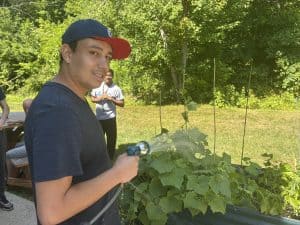 greenhouse adjacent to its Hawthorn Adult Day Health program on Interstate Drive in West Springfield. During the growing season, CBDS clients care for plants, including many vegetable seedlings, inside their Chicopee location before they replant them in pots and raised beds inside and outside the greenhouse. They also work once a week in a garden at one of the CHD Meadows Homes on Longview Circle in Ludlow, growing such plants as tomatoes, potatoes, jalapeno peppers, zucchini, sunflowers, rosemary and basil. Several of the clients are residents in our Meadows Homes program.
“They love eating the tomatoes and seeing how much everything grows—noticing the plants’ progress even in just a week, especially if it has rained a lot,” said Marquez. “They like seeing the fruits of their labor—taking vegetables home and telling their family, ‘I grew this.’ It makes them feel good. Everybody does a little something to help, even if it’s just watering. A few of them don’t like the feeling of the dirt on their skin, especially if they have texture sensitivities. But many of them love to do everything—digging and weeding. They don’t mind getting dirty.”
Community Connections
CBDS Program Manager Raj Basnet said that one of the keys in helping clients build independence and reach their full potential is to facilitate social connections. Gardening, for example, isn’t about just growing plants. It also involves engagement, communication, and teamwork. “We integrate our clients into the community,” he said. “Three of them have newspaper delivery jobs, which they do every Thursday.” Another was employed at Six Flags New England during its 2026 season, and then he worked at the Big E. “They also engage in volunteering opportunities—seven of them, for instance, volunteer at Lorraine’s Soup Kitchen in Chicopee. And we have one individual, Sebastian, who teaches Spanish to the other clients. He came up with the idea of teaching a class,” said Basnet.
Sebastian was pleased by the fact that many of his fellow clients—and staff—jumped at the opportunity to learn Spanish. “I like this program because it’s nice to go out and do things,” he said. “Every year we have a holiday party, and a Halloween party, and this year we had a Black History Month party,” he said. The activity he likes the most: “Karaoke,” he said without hesitation.
CBDS programs in Massachusetts, funded by the Department of Disability Services (DDS), have grown in the past 15 years to expand community connections for adults with developmental and intellectual disabilities, emphasizing integrated, real-world social settings rather than just staying inside a facility. “They’re not just sitting inside a room doing arts and crafts,” said Basnet. “They are out in the community regularly.”
An Evolving Program
“Our CBDS program began in 2018 with nine clients, and in 2019 we had 19 individuals here,” said Basnet, who has managed the program since its inception. “The program closed at the beginning of the COVID pandemic, and seven of them returned when we reopened the program. Since then, we’ve built it up to 22 individuals.”
The high quality of services provided by CBDS is reflected in its exceptional audit results from the DDS Office of Quality Enhancement (OQE) Licensing and Certification Division with scores of 98%, 90%, 99% and 97% over the past four audits.
The addition of an activity coordinator and other staff in the CHD program was “invaluable,” and he has high praise for Marquez. “Ana contacts different organizations to arrange volunteer work, jobs, and community outings for our participants,” he said. “She collaborates with numerous community groups to support participants in joining and engaging in local activities.”
Marquez began at CBDS as a direct care staff member in 2022, and it was soon apparent that her hard work and dedication would lead her to her present role. “I like building relationships with clients,” she said. “It’s great that they feel confident in coming to me when something’s wrong.”
CBDS clients’ life skills training involves safety and social skills development to help them to participate more fully in society with the necessary support. At one recent session, they discussed boundaries with the aid of a slide show from an educational platform called Boom Learning. “Some boundaries are visible, and some are invisible,” explained Meadows Homes Clinical Director Todd Castine. He showed the clients a photo of a house. “This yard does not have a fence, and you are walking by. Do you think it would be OK to walk on the lawn? “No,” was a client’s response.
They also talked about personal boundaries. “Boundaries change depending on how much you know each person,” Castine told them. “Boundaries are different for your close family, your friends, community workers, and strangers.”
The next question: “You accidentally hurt your friend’s feelings,” he continued. “Do you tell them you are sorry? Do you tell them ‘you are being a baby’? Do you ignore them? Do you pretend nothing happened?” The answer, of course, was saying that you are sorry.
The clients who answered correctly received “CBDS bucks,” which are given as positive reinforcement—often for actively participating in CBDS activities—and four times a year they buy items in a “store” at their Chicopee location. The store is run by clients, who, as part of a pre-vocational training, interview for three jobs—item stocker, cashier, and bagger. “The interviews are a good way for them to learn how to communicate with people and manage money,” said Basnet. In the interviews, they demonstrate their functional skills, reliability, and fit for the role.
Since about half the CBDS clients are behaviorally challenged, an important part of the program is changing behaviors using Positive Behavior Interventions and Supports (PBIS), a person-centered framework with strategies designed to decrease behavior that negatively affects the client’s life. “It’s about teaching them alternatives to problematic behavior,” said Castine. “All behavior acts as a form of communication, and unfortunately, some of them had learned that inappropriate behavior can get them more attention than being appropriate. It’s a skill deficit—they don’t know how to tell someone else what they need or want. So if you really get to know them, and know what their triggers are, when they’re having difficulty, our staff offer assistance and teach. That way you can eliminate most problematic behavior before it occurs.”
CBDS also fosters creativity in the participants, providing opportunities for self-expression, confidence-building, and human connection. For example, Direct Care staff Darren Poole creates stories and poems with clients, and leads wordplay games. One of the poems, written by a participant and Poole, uses a “backronym”—an alternative phrase to fit the acronym “CHD.” Read the poem “Calm Healing Dream.”
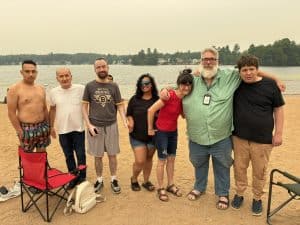
CBDS hosts an annual picnic for participants, their families, and DDS staff. “The turnout has grown each year, making the event increasingly successful. “This gathering provides a valuable opportunity for CBDS staff and families to get to know one another, strengthen relationships, and enjoy a meal together in a welcoming and supportive environment,” said Basnet.
Basnet, Marquez, and Castine agree that the current assemblage of CBDS clients mesh well together. “I’ve never seen such a happy, cohesive group of people in this program,” said Castine. “They seem to have fun and enjoy one another’s company.”
“We have families come in to check out CBDS firsthand to determine if it is something that will benefit their loved ones,” said Basnet. “They see what we offer, and how we handle situations if they arise. And the families are always impressed. In this way, the program sells itself.”