A Passion for Helping People
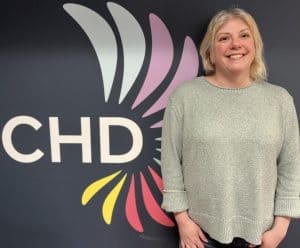 Sarah Babbs Caress originally wanted to be a high school history teacher. “I took the long way around to becoming a social worker,” she said with a smile.
After earning her BA in history at Mount St. Mary’s University in Maryland, she taught sixth grade in the South Side of Chicago through the Teach for America program.
“It wasn’t for me, but it did make me realize that I passionately wanted to help people who are less fortunate,” she said. Caress earned a master of social justice degree from Loyola University Chicago and then worked for the Archdiocese of Chicago’s annual fundraising campaign. After getting married and having three children, she was a stay-at-home mom for 10 years.
Then, a few years ago, she decided that earning an MSW at UConn was an appropriate next step. Maybe she was always a social worker at heart—she tended to be the person whose friends would pull aside and confide in. And then there was the influence of her next-door neighbor when she was growing up in Scranton, PA. “I was raised by my grandparents, and our neighbor, who was very close to them, was a social worker,” she said. “She became like a surrogate extra parent in my life. She was somebody I could talk to—we really connected. I think that really did affect the way I viewed myself as wanting to help other people.”
Caress is now a clinical social worker at CHD’s Pine Street Outpatient Clinic in Springfield as well as at our Park Street Clinic in West Springfield. Her favorite part of her job is meeting new clients. “I really enjoy doing intake assessments, learning people’s stories, and figuring out what services we can offer them and what approach I could take that might be helpful,” she said. “I like putting the pieces together—like trying to solve a puzzle. I find that really interesting.”
And then, of course, seeing a client improve is incredibly satisfying for her. “One of the joys of outpatient therapy, as opposed to working in an inpatient hospital setting, is that you’re with a client for a long enough time that you can see growth when it happens. They’ve learned a new skill or learned how to think differently about their situation.”
Caress pointed out that one of the benefits of working at the Park Street Clinic is its Primary Care program, a cutting-edge initiative that integrates medical care, nursing case management, and behavioral health services. She recalled a homeless client who had severe respiratory problems, but the woman’s next doctor’s appointment was three months away. However, CHD immediately made sure she was taken to the hospital to get breathing treatment. Now she is being treated by Dr. Mariame Kounta, a nurse practitioner at Park Street, as well as by Caress.
“She is doing so much better and she’s about to move into an apartment in Chicopee,” said Caress. “She said, ‘Thank you for listening to me.’ We work with people who are used to not being listened to. They’re used to not being taken seriously and dismissed. It means a lot to them to feel that you do care about their problems.”