A Trauma-Informed Perspective
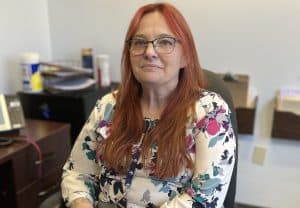 Chassity Crowell-Miller’s well-balanced experience in the field of social work prepared her well for her current role as program director of CHD’s Park Street Outpatient Behavioral Health Clinic in West Springfield—a position she started last November.
After all, as a clinical site director for another agency—one of her jobs prior to coming to CHD—she was responsible for daily operations for a clinic and providing direct supervision to managers and staff.
At one point she was also director of medical case management and housing programs for that organization.
But there was a time she didn’t think the field of social work was in her future: she believed she was going to be a school counselor. “I was a single mom with three kids and I was waitressing and bartending,” she said. “I didn’t want to do that forever, so I started taking classes at Holyoke Community College, and I started focusing on psychology.” Crowell-Miller earned her associate’s degree in psychology at HCC, and her BA in developmental and child psychology at Bay Path University, but then she decided to take the social work route and earned her MSW at Springfield College.
She was especially interested in viewing mental distress symptoms in clients through a trauma lens. “I was able to overcome so much in my life, and I asked myself, ‘How can I help others do the same? How can I meet them where they’re at and help them work on the things that are preventing them from advancing?’”
Crowell-Miller herself has benefited from receiving therapy in the past because she’s had some truly effective therapists. She’s also had some rather ineffective ones. “I think both of those kinds of experiences drew me into leadership,” she said. “I love working with clinicians, helping them develop—helping them learn how to be good therapists. I like to identify the strengths they already have and maximize them, and also work on areas of improvement.”
She said that watching clinicians’ growth is satisfying—comparable to the feeling therapists get when they help clients create positive change in their lives. Indeed, when a client thanks a clinician, this confirmation of the impact of their work is a powerful motivator.
Crowell-Miller recalls one client in particular in her last job, when her agency had a partnership with Springfield Technical Community College to provide students with mental health services. “He was a nursing student with an opportunity to be a travel nurse,” but he was apprehensive about it, she said. “We were discussing this possibility, and he ultimately decided to go for it and go down to South Carolina to be a travel nurse.” This ended their therapeutic relationship, but one day he called her out of the blue.
“I just wanted to thank you for helping me find the courage to do this,” he told her. “My career is going great. I’m getting married in a couple of months, and I never would have met her if I didn’t take the chance.”
Crowell-Miller said this was gratifying because social workers sometimes don’t get to know about their successes. “When clients think to call you when they’ve had something wonderful happen in their lives, it’s a great feeling. It reminds you of why you’re a social worker.”