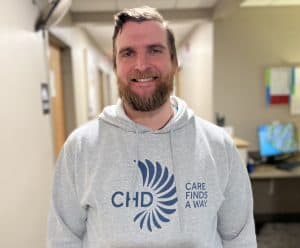
 Ryan Tolle, a clinician at Aster House, CHD’s residential recovery home in South Hadley, feels that Alcohol Awareness Month is a great opportunity to update people’s knowledge about alcohol use disorder and in general alcohol’s substantial impact on health and society. After all, about 178,000 people in the US die from alcohol-related causes each year.
Indeed, in the last 10 years excessive alcohol use has been viewed more and more as a public health problem. He pointed out that between 30 percent and 40 percent of inmates in US prisons were under the influence of alcohol at the time of their offenses, and alcohol is often a major factor in people dying by suicide—approximately one-third of all who die by suicide in this country do so during acute alcohol use.
“Alcohol use has a lot of severe repercussions—it’s involved in more than half of all domestic violence incidents, it’s a major driver of community violence,” he said.
Tolle sees firsthand the effect of alcohol use disorder on Aster House clients, either through alcoholism or alcohol being the gateway drug that has led to other addictions. Why is problem drinking so prevalent? For starters, it’s no secret that alcohol consumption is deeply embedded in society—normalized through widespread marketing and easily available. “There is no middleman when it comes to buying alcohol,” he said. “There is no waiting around. Unlike illegal drugs, you don’t have to wait for some guy who might be getting tailed by police or worry that a dealer might rob you. You can buy alcoholic beverages in a grocery store.”
Alcohol is also entrenched in celebrations of life milestones and ingrained in professional and collegiate networking. “It’s associated with achievements, and there are many people who, when they start getting sober, start asking things like, ‘Will I be able to share a beer with my son when he turns 21? Will I ever be able to have glass of wine with my wife at a wedding?’ You also see it as a coping skill in the media,” he said. “In the movies, some guy is going through a divorce and he’s at a bar—you don’t see him handling his problem in a healthy way.”
Conversely, the media paints a picture of someone with a “drinking problem” through an extreme stereotypical lens. “In movies and on television, you see an individual who’s homeless, drinking a bottle that’s in a brown paper bag,” he said. “You don’t see the very real people who have an addiction that are very high functioning in the sense of keeping a job and paying their bills—but at the same time struggling in other areas—their confidence, their family relationships, and their goals.”
Tolle also points out that alcohol use disorder and other addictions in an individual are rarely unaccompanied—dual diagnoses are common at Aster House. The statistics bear this out: according to the American Medical Association, 37 percent of people with alcohol use disorder have at least one serious mental illness. “At Aster House I see a lot of people who use alcohol or drugs to cope with severe mental health issues,” he said. “For many, addiction was once a coping skill that worked for a long time, but it got to the point where it didn’t work anymore.” Because mental health and substance use disorders are often interconnected, at Aster House there is a balance of mental health and substance use treatment with daily clinical, behavioral, and recovery treatment groups.
Aster House is also well-prepared to help those they serve bounce back from setbacks. Relapses occur in recovery, especially early recovery, but Tolle said that the point is not to let it be a downfall, but a learning opportunity. “It’s not that we normalize relapse here, but we understand it,” he said. “It doesn’t mean that you lost all the education you’ve gained in recovery. It’s an opportunity to look back and see what worked and what didn’t.”
Tolle, who earned an MA in mental health counseling at Westfield State University, went into the recovery field six years ago after being in alcohol recovery himself, although he doesn’t let the fact that he had a substance use problem define him. “It was an experience to overcome, like many other difficult things in life that teach you great lessons,” he said. That’s why Alcohol Awareness Month is an opportune time for people to step back and think about their relationship with alcohol and how addiction can creep up on them. “Alcoholism is a very insidious disease in that it does a great job at convincing everyone that it will never happen to them,” he said. “Until it does.”
If you or someone in your life needs help with substance use issues, you can call 1-844-CHD-HELP or visit chd.org/contact-us.