Overcoming Disability and Providing Inspiration
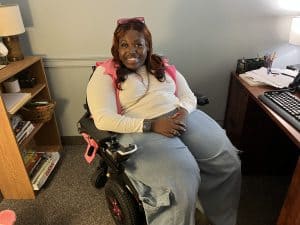 After Dr. Kandice Jones, a clinician at CHD’s Park Street Outpatient Behavioral Health Clinic in West Springfield, earned her Ph.D. in mental health counseling from American International College in 2024, she had a celebration at the Basketball Hall of Fame. Among the guests was Springfield Mayor Domenic Sarno, who proclaimed Saturday, December 7, 2024, as “Dr. Kandice Jones Day in Springfield.”
City Councilor Lavar Click Bruce then joked that there is a “Dr. J” in the Hall of Fame and that on that day “Dr. K was in the house.”
The get-together was a way to celebrate her achievement and to thank people who supported her because she had overcome enormous odds. Dr. Jones, when diagnosed with cerebral palsy as an infant, was not expected to thrive by her doctors, who told her parents that the oxygen deprivation to her brain when she was born prematurely would limit the use of her limbs and would severely affect her cognitive functioning.
Dr. Jones, who uses a wheelchair, did experience speech and developmental delays, however, she relied on her family, faith, and determination to reach her goals. Prior to her doctoral degree, she studied human services at Holyoke Community College, received her bachelor’s degree in social work at Westfield State University, and earned her master’s degree in education with a concentration in mental health counseling at Cambridge College. She was a mental health counselor at CHD’s State Street Outpatient Behavioral Health Clinic in Springfield before becoming a clinician at our Park Street Clinic a year ago.
Motivating Clients
As for “wins” in her career, she recalls a client at State Street who suffered from severe depression and is now a behavior technician. Last year, Dr. Jones ran into her at the National Alliance on Mental Illness art show at the Chicopee Public Library, where several State Street art therapy clients exhibited their artwork. “She was grateful that she was provided with the tools she was able to utilize to help her lead a productive life helping people,” said Dr. Jones, who was also happy to see at the show artist Kaiser Martin, one of her former clients. “I always reminded him of the influence he had on the other clients in the art therapy group, and it took him a while to understand that,” she said. “But I was glad I was able to plant that seed in him, because now he’s able to be that shining light to others in the group.”
Dr. Jones’ favorite part of her job is being able to inspire and empower whoever comes into her office feeling down. “A lot of them feel like they’re alone—that they’re the only ones going through this,” she said. “I tell them that they don’t have to face it alone, and that no one in this world achieved something great alone. I earned my doctorate, but I didn’t do it alone. There was always somebody in my corner cheering me on.”
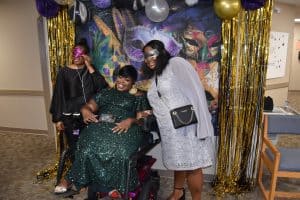
Indeed, throughout her life her family has been incredibly supportive, even to the point of her twin sister Kaprice essentially spending a year with her in Shriners’ Hospital when they were both nine years old, constantly playing board games and watching movies with her in the building’s atrium. It is a family of givers and public service is a common denominator: her father, Kelly, is a retired Springfield Fire Department lieutenant. Her siblings are all in the human services field: Kaprice is a board-certified behavior analyst tor autistic children in Nebraska. Her older brother, Kelly Jr., worked with troubled youth as he pursued a master’s degree in divinity at Eastern University and is now supervisor of community engagement at the Temple University Health System, and her younger brother, Quentin, works as a program director with at-risk boys aged 9-16 at the Key Program in Springfield.
A Defining Moment
Dr. Jones truly believes in the power of resilience, but there was a time when she contemplated the hand she was dealt with at birth and wondered, “Why me?” She recalled one day when she was 15 and she was sitting in her room in the dark. “I tell this story all the time, and I’m going to try to tell it now without crying—because I typically cry at this point,” she said. But she took a breath, kept her composure, and continued. “I saw all my siblings growing up and developing normally, while I had to go through all these surgeries and hospitalizations. I wanted to have a regular life like them, and I just had a moment when I said, ‘This is too much for little old me.’ So I did say, ‘Why me?’ And then I had a pep talk, if you will, with myself. I told myself that I can use my experience to motivate people and give them hope. At that point I made the decision to not wallow in self-pity but use it as fuel to accomplish the things I want to accomplish.”
To be sure, Dr. Jones has no problem leveraging her experiences to help clients. “I use my story all the time,” she said. “I tell them that I can overcome this obstacle—not to minimize their multiple obstacles—but I let them know that they can use their tenacity as a driving force.” She said that long ago she could have used her disability as a crutch to do less than she is capable of—but she decided to be an inspiration to others.
She is also a firm believer in affirmations: framed on her walls are sayings such as, “I am worthy of my dreams and goals,” “I am determined to make a difference,” “I am thankful for all of the talents I have been given,” and “I am optimistic about my future.” She admits that these statements may seem corny at first, but they can be effective. An affirmation can help rewire the brain to overcome negative self-talk. “The more you say it, the more you start to believe it, and it begins to sink into your mind,” she said.

“I will tell a client, ‘Practice saying today is going to be a good day. Go home and try it and let me know how you feel.’ And sometimes they say, ‘Nope, I know that’s not going to work.’ But then they try it and they say, ‘It was a little weird at first but it made me feel good throughout the day.’”
The most challenging part of her job, she said, is that she tends to take her work home with her—in that someone she just had a session with will be on her mind for a while and sometimes she struggles to “leave work at work,” carrying her clients’ stories long after she leaves her office, which can lead to emotional exhaustion. To avoid this, Dr. Jones practices self-care, and she also uses the love of her family as an anchor.
“My family is still a big support system to me—they can be overprotective, even at my age, but that’s OK,” she said. “My faith in God also grounds me. It’s a huge source of hope for me and helped me get to where I am today.”
This all certainly factors into her can-do attitude, which can be traced back to that day when she experienced a rebirth of sorts at age 15—a moment when she put herself into a mindset that is reflected in a saying she has in her CHD email signature. It is also a message she has for every client: “Within every person is the strength to rise, rebuild, and renew.”