Solidifying His Recovery
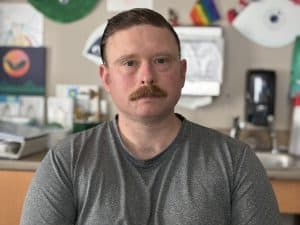 Thomas didn’t have his first drink until he was 21, which is unlike many with alcohol use disorder, who usually begin drinking in their teens—or even earlier.
“I started a little later in life, but it didn’t get out of control until my brother passed away in 2016,” he said.
Two years ago, Thomas said enough was enough, and he went for treatment at Aster House, CHD’s residential recovery program in South Hadley, for a six-month stay. Back then he also tried Alcoholics Anonymous, “however, I didn’t do it the right way. I didn’t solidify my recovery,” he said.
Then, last March, his wife of 23 years was killed in a car accident. Shortly after, he relapsed, and he called a friend to take him to the hospital. The Department of Children and Families took his children, aged 17, 13, and 12. “That gave me the motivation to do the right thing” and go back to Aster House, he said. “It wasn’t easy, but I made the right decision.” Thomas went to detox, and then a clinical stabilization services program. Now he is in his third month at Aster House and has been sober for more than 100 days.
Thomas is also back with AA, though this time he is working through the process differently. “It’s not a focus on saving a marriage,” he said. “Now I basically have to save myself so I can be there for my kids.”
He is also being treated for depression, anxiety, and PTSD. “I lost my father to addiction,” he said. “He was 40—the same age I am now.” Thomas also witnessed a murder in 2000—the shooting death of a 15-year-old boy in Holyoke right in front of his eyes. “That was kind of rough. I had PTSD from that incident.” he said.
Thomas tried to moderate his drinking in the past. It didn’t work. “I tried to play with that gray area, but it wasn’t something I could do,” he explained. “I said, ‘Oh, I’ll just have wine.’ But I ended up drinking more of it, and then I was drinking the stronger stuff again. It was a slippery slope.”
He has a recovery coach and a sponsor, and he enjoys the therapy groups offered by Aster House. “They started a grief group,” he said. “I have a grief workbook which has been very helpful. It gets easier to talk about every day.” Another group he finds beneficial is psychoeducation. “It’s good to learn about different disorders—not just my own, and I’d like to go to school and get into this field and see where it takes me,” he said. He is looking into coursework related to peer recovery at Holyoke Community College.
In the meantime, he is embracing the support he receives from Aster House. “It’s very individualized care,” he said. “I love it here. You’re not just some number. This program has been fantastic.”