“It was looking pretty bleak for a while”
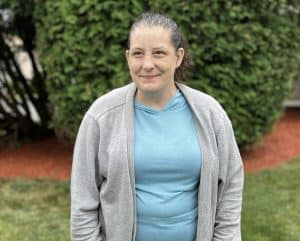 Danielle Irwin, who receives services from CHD’s Outpatient Behavioral Health Clinics in Easthampton and on Pine Street in Springfield, doesn’t mind sharing her substance use recovery and mental health journey with others—especially if it inspires hope for someone who needs similar help.
The Chicopee native has depression and anxiety that she believes are rooted in the trauma losing her mother, who was a truck driver, in an accident in 2000. Irwin was just 15 when this happened, and that’s when her substance use and mental health issues started. “I started to dabble with this and that—mostly alcohol and marijuana—and then in my early 20s it progressed to cocaine,” she said.
It was another accident, however, that truly sent her life into a tailspin. For her injuries in this car crash she was prescribed Percocet, and she became addicted. She began buying painkillers in the street, “and then that progressed to heroin,” she said.
Because of her lifestyle, her son was removed from her home shortly after he was born, when the state Department of Children and Families (DCF) obtained temporary custody of him. “It was looking pretty bleak for a while,” said Irwin. But then she got her boy back when he was 18 months old.
“I had therapy on and off from my teen years on, but it didn’t really help me much,” she recalled. And when her son was taken, she felt she was in a hopeless situation. Then she got connected with Clinician Mary Loomis, now our Easthampton Clinic program director. “It was really different this time,” she said. “It felt like she was really listening. With some of the other therapists I had at other agencies, it felt like they were just sitting there, taking notes. It didn’t feel like they were really partaking. I was talking, but there was no feedback, really.”
She credits Loomis, who she has been seeing for seven years, with also encouraging her to keeping a file of the treatment and services she was receiving to show DCF—including drug counseling, meetings, participating in an Intensive Outpatient Program, and parenting classes—so her case involving the custody of her son could progress toward reunification.
What would she tell anyone who is thinking of getting professional help, but is reluctant because of a fear of being stigmatized? “I would say it’s worth giving it a try, and you can stop if you determine it’s not for you,” she said. “A lot of people don’t understand that what they have is treatable. Also, at CHD, there are different therapists available. If you feel that you’re not clicking with someone, then you can try someone else.”
Irwin feels that it’s “empowering” to tell her story. “Not too long ago, it was really hard for me to do that, because I would feel that stigma,” she said. “Now, it helps me feel connected with other people. In talking with others and hearing some of their stories, it helps me feel not so alone.”