Rewriting Stories
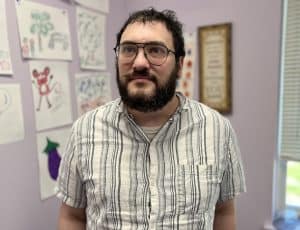 Scott Feldman’s first career was in journalism, when he was a self-described “jack-of-all-trades” for different news organizations as a reporter, photographer, editor, and videographer.
After majoring in journalism and history at UMass, the South Hadley native got his start at local weekly newspapers before writing news for daily papers in South Dakota for several years.
Then he returned to western Massachusetts to work in marketing positions before taking a job as an overnight call taker at a hotline for mental health, emotional support, and suicide prevention at the United Way.
Feldman, who is now a clinician at CHD’s Pine Street Outpatient Behavioral Health Clinic in Springfield, found that transitioning from journalism to his present role involved leveraging his skills in gathering information, deep listening, and breaking the ice with strangers. He found that the two seemingly disparate fields have more in common than one would think.
“I really like talking to people, getting to hear their stories, and having them open up to me to learn more about them,” he said. After he dipped his toes into the mental health field at the hotline, he decided to dive right in and earn his MA in counseling at Westfield State University.
Clients trust him to listen to their experiences and feelings as he determines with them how their lives are out of balance and helps them manage their conditions. “The most rewarding sessions are when, within the midst of conversations, clients come to realizations on their own, and make improvements in their lives,” he said. His favorite moments are when someone thanks him for his help—when they say, “I really appreciate you, Scott. That was a really good session— I feel a lot better now.”
As for major “wins,” Feldman recalls a client with severe psychosis who was homeless and jobless for seven years. Colleagues managed to get him support through CHD’s Adult Community Clinical Services (ACCS) and then outpatient therapy. “Now he has an apartment with his sister, he’s working full-time, and he’s going back to school to become a Certified Nursing Assistant,” he said. “He’s making a lot of headway and is consistent with his appointments.” Feldman also mentioned a woman who was diagnosed with major depressive disorder, as well as PTSD, generalized anxiety disorder, and bipolar disorder. She was also using substances, which led to incarceration, and she lost custody of her children. “Since then, she has been sober, and she’s rebuilding relationships with her kids,” he said.
Feldman believes that Mental Health Awareness Month is an opportunity to fight the stigma of seeking treatment. “There is still stigma, and even though it has been reduced over the years, there’s still work to be done,” he said. “Mental health is as important as physical health—there are innumerable studies showing that stress, for example, has physical side effects. The connection between the body and mind is undeniable. They are intertwined.”