The Gift of Peace of Mind
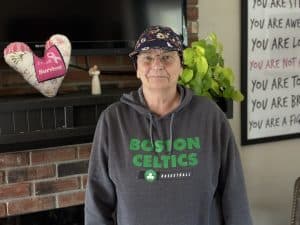 CHD Cancer House of Hope member Ruth Chappel, 74, almost ignored scheduling her annual mammogram last January. “My doctor was retiring, and she set me up for an appointment, and I said to myself, ‘Maybe I won’t even bother,’ because I get a mammogram every year, and I’ve been fine,” she said. “I almost didn’t go. I’m glad I went.”
Afterward, her doctor’s office called her back for a diagnostic mammogram, which, unlike a typical screening exam, is a detailed series of X-rays taken from different angles, zooming in on a specific area of concern.
It turned out that Chappel needed a biopsy, which concerned her. At the same time, she felt healthy and cautiously optimistic—despite the callback. She recalled her first mammogram at age 40—which is the recommended age to start annual mammograms for women of average risk—and the doctor ended up finding a fibroadenoma, which is a common benign breast lump containing glandular and connective tissue. “I had surgery for that, and it was non-cancerous,” she said.
This time, though, she had breast cancer. Fortunately, it was Stage I. “I had a clear mammogram a year before, but this was a pretty aggressive cancer,” she said. She had what is known as triple-negative breast cancer, an invasive disease in which the cells test negative for estrogen receptors (ER), progesterone receptors (PR), and HER2 protein, so standard hormone therapies and HER2-targeted drugs do not work. This type of breast cancer tends to grow, spread faster, and have a higher risk of recurrence compared to other subtypes.
“I was in shock,” said Chappel. “I just kept saying it’s not possible—I try to eat right, and I exercise a lot. I teach exercise classes.”
She underwent surgery, and then chemotherapy and radiation. “It was appointment after appointment,” she said, and it was physically and emotionally draining. “I am thankful to my family and friends that helped me manage it all. I’ve since started offering rides to appointments to anyone recently diagnosed.”
What Cancer House of Hope has given her is relaxation and peace of mind, with 10 Reiki sessions so far and several massages. CHH also boosted her confidence after she was fitted for a wig after she experienced hair interruption, with Cancer House of Hope volunteer Joan Quinn, a former hair stylist, assisting her. “She told me to send her a picture of me when I had hair, and then she picked out the perfect wig for me. The color was just right,” she said. “People don’t know that it’s not my real hair.”
She said that most of Cancer House of Hope’s volunteers have been touched by cancer “and they are very encouraging and helpful.”
Although many people feel supported by Breast Cancer Awareness Month’s events and activities, Chappel is aware that some patients and survivors actually dislike the campaign because they are overwhelmed with painful emotions in October. Others think Breast Cancer Awareness Month, with pink ribbon merchandise, can be a distraction from the need for better understanding of breast cancer and more clinical research leading to better treatments. “I did read about a woman—a doctor—who went through breast cancer twice, and she hates October because Breast Cancer Awareness Month triggers so much in her,” she said. “But I haven’t felt that way at all.” And as for research, Chappel participated in the Rays of Hope walk on October 18. “My team raised $2,200 toward breast cancer research,” she said.
Chappel also appreciates Breast Cancer Awareness Month’s emphasis on early detection. “I’ve met people who have NEVER gone to a screening—and they’re MY age,” she said. “So I would say that the importance of getting annual mammograms is definitely a worthwhile message.”